Monday, December 17, 2012

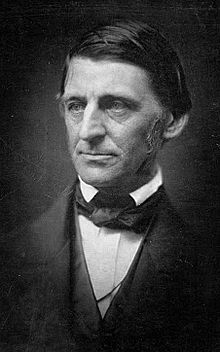
Readings: Ralph Waldo Emerson


After reading John Updike 's autobiography, I picked up a book from another New England writing institution and author from Harvard (but I go rather backwards in time, Updike is fairly contemporary). Ralph Waldo Emerson's writings hint at an extraordinary lifetime of journal-keeping. You may have read his witticisms here and there (for example, “Build a better mouse trap and the world will find a path to your door”), but few know he inspired an entire thought revolution of his own, called Transcendentalism.  To cut a long story short, his theories will appeal to secularists, idealists, individualists and to all those who believe in the inherent goodness of human beings. Emerson opines that souls act (or "transcend the material world") as vessels of god.  Transcendentalists regard spiritual power as the core content of human capacity. You can summarize that Transcendentalists are sort of romantics; they mix this romanticism with ample religious seasonings. Importantly, they are staunch believers in the will in power of humans which overcomes any incidences of fate, which makes them closer to the pragmatists.
A word about his writing style prevalent in the nineteenth century: Emerson (hereon mentioned as RWE) sounds like a clergyman. He places himself high above the 'hoi polloi', to justify, sermonize and preach. Indeed the control over his words is so superior to the mortals that you want to read his sentences twice, thrice and once more to understand his powerful proclamations. But in all fairness, RWE is hardly a fan of logical flow; he meanders, often from one exaggeration to another. You can miss an entire page and leap on to the next only to find several more of his magnificent wordy-ornamentations extended to one brilliant sentence.
I usually do not 'dog - ear' my books, but Emerson is so full of wisdom, literally entire pages are written magically.  In this post, I will share excerpts from various readings which struck me most. [In square brackets, you will find my ponderings.] Overall, he is so inspirational that even a born cynic will question himself/herself after reading RWE. 

On Power of Individuals / Essay “Self Reliance”

The man must be so much, that he must make all circumstances indifferent.
[Now, he will induce a new line of thought to the powerful provocation above]
Every true man is a cause, a country, and an age; requires infinite spaces and numbers and time fully to accomplish his design; and posterity seem to follow his steps as a train of clients.
[There is point after which you stop to question this extreme idealism. To think or assume anyone will have infinite time and space to accomplish their grand design? And have you met anyone short of an insane genius who knows their grand design? But, you will still find several nods in agreement over RWE’s rhetorical rhyme.]
A man Caesar is born, and for ages after we have a Roman Empire. Christ is born, and millions of minds so grow and cleave to his genius, that he is confounded with virtue and the possible of man. An institution is the lengthened shadow of one man; as, Monachism, of the Hermit Antony; the Reformation, of Luther; Quakerism, of Fox; Methodism, of Wesley; Abolition, of Clarkson. Scipio, Milton called "the height of Rome"; and all history resolves itself very easily into the biography of a few stout and earnest persons.
[Hence proved! Hail RWE!]

On Permanence and Fluidity / Essay “Circles” 

There are no fixtures in nature. The universe is fluid and volatile.
[Powerful provocation introduced]
Permanence is but a word of degrees. Our globe seen by God is a transparent law, not a mass of facts. The law dissolves the fact and holds it fluid.
[He quotes a quasi- religio-scientific factoid to support his assertion above]
Our culture is the predominance of an idea which draws after it this train of cities and institutions. Let us rise into another idea: they will disappear. The Greek sculpture is all melted away, as if it had been statues of ice; here and there a solitary figure or fragment remaining, as we see flecks and scraps of snow left in cold dells and mountain clefts, in June and July.
[Hence proved again, RWE is so beautifully convincing!]

On Poets and the Rest of ‘Them’ / Essay: “Poets” 

[The point where I agree (I find myself bit of pragmatist than swaying in idealism) with RWE is his sense of classifying people, and his allergy to superficiality in them. In this essay his major objective is to glorify poets and sort of make them seem heroic in contrast. I mean, I agree with him, in my opinion, there is something extraordinarily under-rated about being a poet: in general, we have no concerts, no applauses, and no photo shoots…all we maintain is a silent thought in our head of being “different” and “sensitive” than the rest of the junta. And then there are the “rest” which seem to us like shallow showoffs, and who obviously do not read what we write. ]
“Those who are esteemed umpires of taste are often persons who have acquired some knowledge of admired pictures or sculptures, and have an inclination for whatever is elegant; but if you inquire whether they are beautiful souls, and whether their own acts are like fair pictures, you learn that they are selfish and sensual. Their cultivation is local, as if you should rub a log of dry wood in one spot to produce fire, all the rest remaining cold.”
[He contrasts the “rest” now with poets and great thinkers]
“But the highest minds of the world have never ceased to explore the double meaning, or shall I say the quadruple or the centuple or much more manifold meaning, of every sensuous fact; Orpheus, Empedocles, Heraclitus, Plato, Plutarch, Dante, Swedenborg, and the masters of sculpture, picture, and poetry.
For we are not pans and barrows, nor even porters of the fire and torch-bearers, but children of the fire, made of it and only the same divinity transmuted and at two or three removes, when we know least about it”
[Poets are children of fire, a portion of divinity! Such hyperbolic imagery! But then don’t you agree with the fella?]

RWE on Politics/ Essay “Politics” 

[You would think that an idealist would desist to provide his two pence worth on matters like politics. But RWE is no shy idealist. He has an opinion on all matters material to the ways of the world. That’s where the pragmatist in me, gulps his essay down with keen interest]
“We live in a very low state of the world and pay unwilling tribute to governments founded on force”
[How terrible it is that the natures of governments have not changed since more than two centuries.  This statement could still hold valid. Do I want to fund wars? Do I want to fund corruption and inefficiency? But I am an unwilling participant in the evils through the nexus of the governments that force me to participate in the entire process. On a related note, transcendentalists are noted tax avoiders, look up Thoreau.]
“What satire on government can equal the severity of censure conveyed in the world “politic”, which is now for ages have signified cunning, intimating that state is a trick?”
[Again this is so true and accurate for contemporary times! We, the people, associate politics with savage social interactions meant exclusively for a few foxes, not knowing that even if we sit on the fence, we are very much part of the game . So, we are satisfied alluding ourselves, only the trick is still playing on us!]
[And now moving on to RWE’s recommendations on politics]
“The power of love , the basis for the State have never been tried”
[Duh!]

Other mentionables: 

[RWE has some gurus, Thoreau being the most revered one. RWE devotes an entire essay on the eccentricities. On his ideological opponent, Montaigne  he casts a pointed and verbose attack in an another essay, placing idealism above Montaigne’s preferred skeptical realm.]  
 “Our America has a bad name for superficialness. Great men, great nations, have not been boasters and buffoons, but perceivers of terror of life and have manned themselves to face it”
[A classic take on America, again targeting superficiality and purposefully romanticizing Sparta, Greece and the classical republics.]
There are several of such gems that gave me food for thought, and I mulled over this book for the past month. And I must devote two different posts, one on his essay on “fate”, and one exclusively on his poems. I must say, to me he is better poet than an essayist. His language style and ruminating persona echoes well in his poetry.  I will cover that in upcoming posts.

Sunday, October 28, 2012

Trek to Brahmagiri


One of the perks of being in Bangalore is the excellent excursion options. So it did not take too long to plan a trek. This was one weekend, we decided to go trekking with a completely unknown group, exception being my brother and one of my friends. This was first time I stayed overnight for a trek, so we had to do some packing, and later we got to know it wasn't well done. 
To reach Brahmagiri we traveled overnight in a rickety and noisy bus, where we met our fellow journey men. 
Brahmagiri, is a protected forest and this range is on the border of Kerala and Karnataka. The highest peak, which was also our destination, is 5262 feet (1604 meters) high. We first needed the forest department's permission to enter the wildlife sanctuary area. We had breakfast and got ready for the trek after morning ablutions in a very humble rest room, where we shared one bathroom among a dozen people. Unknown people, again, in highlights. 
The trek's first milestone is Irrupu falls, which happens to be sort of first staircase. It would have been actually a shorter way to climb up this, but there is less dangerous trekking path which takes you deeper into the forest, up some hills and lo! you would reach the same elevation as the waterfall. 


In the above photograph, you can see the falls, the forest is quite rocky, dense and green.You know you are deeper in the wild, when elephant poo becomes a regular sight and also you see lot of cobwebs. Basically we kept walking about 6 kilometers the first day, and reached a forest rest house  up in the hills by sunset.


Now the rest house was just a shed with two rooms and two "toilets". We were also carrying our supplies, backpacks and sleeping bags. For more water, we had to go downstream and fill in all the utensils in store at the guesthouse. We also collected firewood for the dinner and bonfire. I was in no mood to take pictures doing such "prehistoric routines". Trekking was not harsh for me, but the thought that we were half way for day 1 and the next day will be the real deal, was pulling me down. Some of the guys decided to go for a nearby rocky peak. I decided to stay put in the guest house as between me and my brother we did not have enough warm clothes. I was a bit uncomfortable since the locks weren't working and there was no electricity there but I told myself I have to choose well. If I do not rest now, I may not be up for tomorrow's ordeal. Plus I did not want either me or my brother to fall ill because we did not anticipate the chill. After the group came back from their peaks, many of them were not in ace condition and many had too many red-bulls on the way. Not my party. I let the group "do the dinner"...couldn't expect luxury but the hot noodles were quite a relief in the cold windy night. We played some dumb bonfire games and cracked some jokes, but I could clearly see signs of no team bonding. For most of the people, they had their cosy clique, and they had done several treks together. I had my clique too, and I was least bothered (I could tell they found that haughty!). This is the first time I slept on the cold floor in my sleeping bag. The rest house was so full with such packs! I was just happy for the basics: a roof on the head, a sleeping pad, bottle full of water and my torch. The point is, when you are townie, you lose that gratefulness for nature. You expect luxuries. I adapted well, I was so elated to just be. 
Next morning, we were up at 5AM. Warm clothes were now a SERIOUS issue between me and my brother so we borrowed a light jacket. The forest guard now had to compulsorily escort us to take us to the peak.  Seeing the sun rise was brilliant. 
Soon we were deep enough in the jungle to hear and see elephants (up-till now it was majorly a sight of their substantial fecal matter). We could also view our destination! This is the part of the trek I enjoyed the most...the horizon changed every five minutes!


We crossed many smaller "peaks" and rivulets and walked about 4 kilometers more.


Here is a picture of the Brahmagiri peak from the foothill.


Climbing this was not an easy task, as it seems. There were steep elevations and loose soil, which made it inevitable that you hit a few rocky patches while climbing it. Every once in a while it helped me to look down and see how much I 've covered. The views were fantastic and worth it. 


 The forest guard was in the meadows in the foothills and sort of acted as a meeting point for us to reassemble, since our pace was different. Though I was leading the pack till the foothills, I stopped too often while climbing to take breaks. My brother and friend had overtaken me since a long time. The last mile was tough for me. I was glad on the way back as caught up with the herd. The trek was not over yet. We had to go back to the forest rest room, pick up our stuff and climb all the way down till Iruppu. That was the fun part too. We stopped at streams to clean leech bites and finish remaining food packets.  
Irrupu was no surprise as we walked back the last 6 kilometers from the rest house. We rested at the falls and then came back, where our bus rested to take us back to city life. We requested the bus driver to take us through Bandipur National Park, where according to my friend, "deer were like dogs". 
Meanwhile, cliques had thickened. Brother and I found ourselves looking forward to some clean socks.  We stopped in Mysore for dinner and told ourselves: glad we made it back from the wild. It was almost nighttime and next early morning we would reach Bangalore. 


Sunday, October 21, 2012

Returning to the "ghost blog"


 Well, this blog has been a bit fallow for the time being. The blog ratings are at an all time low ( by a notch of one or two :)). Even the feel has changed, Blogger has now been integrated with Google (it;s been that long since I noticed!). But I am BACK. Part of the problem has been a long standing inertia to do anything creative online than Facebook, search for my own laptop, and a rather extended writer's block. I have been off reading as well (inputs have an effect on outputs, system approach!). Except ONE good read in the past few months. John Updike's brilliant autobiography titled "Self- Consciousness". The book resonated with me even though he talks in the truly small town and American context. Updike, a perpetual Pulitzer prize winner , shows how beautifully satisfying humdrum can be. The way he describes his skin condition and how it helped him to focus on the "inside", how he talks about his humbling socio- economic status but a distinctive intellectual prowess, really stayed behind even I as put down the book. His appeal is universal and his language is SO powerful.


Other than this, I've carried on the daily dose of news through Pulse. 

The good thing about this android application is it helps me to customise my reading habits and has an excellent navigation experience as a news hub.


About films, I have watched a lot of popular bollywood cinema very much latest. I really liked the "Gangs of Wasseypur" series. It really stands out owing to its rustic feel, raw and bizarre characterization, and brings the underbelly of regional cronies to light. Besides that, I found that I am big fan of Ice- Age really !


I was off TV for a year (replaced it by high- speed internet), but the jinx was broken, thanks to big screen experience and my brother, I have been able to watch football/soccer like never before. I can now tell Rooney from a Lampard. That good :)

 So in the year I was away from TV I discovered some gems: some excellent series: An Idiot Abroad (mastermind of Ricky Gervais),  Topgear (hosted by oh-so-charming petrosexuals, Jeremy Clarkson , May and Hammond) and Three part BBC series on "Story of God, hosted by Sir Robert Winston stand out from the usual dose of popular sitcoms.

Now to important stuff, I still haven't yet decided the pointed topic for this blog, so I am continuing it to be my random soundboard, Any one bored or interested enough is free to caste a judgement on what comes out of my writing pad.


Sunday, January 01, 2012

Goodbye to 2011, Hello to 2012 post


Whoa, surviving 2011! Phew!
Hopes and dreams and everything in between. Here are some things that characterised 2011:

1) Uphill Climbs 


2)France!


3) Bank!


4) Friends!


Tuesday, September 06, 2011

My stint as a guest writer...


Here is a story about the Indian education system which I wrote for a Norwegian colleague's blog . 

You can follow and read his blog at http://nor2ind.wordpress.com/

Indian education system is as diverse and layered as the nation itself. It’s got multiple influences and it would be difficult to isolate the various philosophies and motivations that guide it to its present shape. Yet, today’s education system is mainly dominated by “western” concepts and pedagogy, though India has had its own unique tradition of organized educational institutions since times immemorial. In the recent past, we in India have inherited among others, a mainly anglicized, socialistic and bureaucratic education system, which as per many critics, leads to straitjacketed students. In my opinion, the system has failed to evolve to the local realities and changed global scenario. Education is still not an industry in India (organizations or individuals cannot be profiting from educational institutions in accounting terms and only non- profits can run registered/accredited institutions even though 100% foreign direct investment is allowed).
All said and done, education is a very important element for India’s socio- cultural setup and a way for economic and even social empowerment for Indians. Consider these facts which may be interesting to you:
-          Hindus have a goddess dedicated to education, learning and wisdom, Saraswati.
-          In India, the Guru or the teacher is held in high esteem.  There is a Sanskrit verse that if the devotee were presented with the guru and God, first he would pay respect to the guru, since the guru had been instrumental in leading him to God.
-          In ancient times, a Gurukul was a residential type of school in India, where pupils lived in proximity to the guru. The Vedas or ancient texts of the Hindus , have classified a lifetime of 100 years, out of which the first 25 are best spent in bachelorhood and in pursuit of education , and termed as the stage or “asharama” of “Brahmacharya”, which is followed by “Grihastha”/Domesticity, and “Vanaprastha”/ Reflection and “Sanyasa”/ Renunciation.
-          Nālandā is the name of an ancient university, a Buddhist center of learning from the 4th to 11th Century.  It has been called “one of the first great universities” in recorded history.
During the colonial period, significant changes were effected in the system of education. It was then that knowledge of English language became the de- facto ticket to government jobs and provided expanded access to trading opportunities. The rise of English print media and establishment of Universities and convents were some of the direct implications of the rising acceptance of English as a uniting factor in a nation of multiple languages. In a way, this period marked the first important phase of globalization for Indian education system. Though this phase also lead to a gap between vernacular and English languages, which is still a struggle and subject of policy debates in this nation.
Following independence in 1947, Maulana Azad, India’s first education minister recommended a strong central government control over education throughout the country, to ensure a uniform educational system. Such a system may be ideal for a largely homogenous and smaller nation like Norway, but for a diverse and huge nation like India (with 23 constitutionally recognized languages) it meant that the state intervention clashed with regional and local educational needs.
Today, every child between the age of 6- 14 is guaranteed primary education by the state in India. However, the goal of universal education still remains elusive as the quality and access of schooling and basic educational infrastructure remains a challenge. India still suffers from the chronic anomalies in the government dominated educational system. 3 out of 4 of schools in India have one teacher for several classes in a single classroom. 
At present the literacy rate is 74% in India, and it may be noted that there is a gender divide hidden in the average figure, with only 65% literate females as opposed to 82% literate males. Rural India has the lowest literacy rates in Asia.  As India becomes a global outsourcing hub, one portion of India is using its English skills and higher education as a competitive edge over other nations like China, there is the “other” India struggling to become literate or use its education into employable skills to climb up the developmental chain.

Tuesday, August 30, 2011

Trek to Naneghat and Learning for Life!


I lead a sedentary yet 24x7 lifestyle of a consultant. I like to indulge in epicurean delights. This lifestyle is perfect to make me an indulgent sloth during the weekend. Last Saturday was different, I decided to push myself and enroll for a company trek. Travel is my only respite from the rigors of the corporate life and I decided to make most of my last month in this state. I did some basic research online on the destination Naneghat and non-nonchalantly put in my application and fee. My co-located coworker friends, thought I was far too quick to take an independent decision and we quickly realized that  it wasn't going to be fun if some of us do not go together. So I left it to them to decide the fate of my application. Either all were going or none. Luckily all of were prompt to organise ourselves and met on time for the T-day. Only thing was, that Mumbai rains were playing havoc since Friday night and were showing no signs of halting. 
On the day of the trek, I realized that too many people like me wanted to climb Naneghat at 3000 feet! It was a relief to see some familiar faces too. I was a bit sleepy from last night's movie marathon and my overall laziness was evident from the fact that I decided to wear my worn out Nike pair instead of buying some specific trekking footwear. So far so good, except I had no clue about the actual trek conditions. As my co-trekker, Karsten writes in his blog : it started as if it were a walk in the park to become more tedious.  Ultimately we had to walk through a steeply rocky and slippery pass to reach the peak.  The peak was a rendezvous with the clouds!

Image from: Sanket Sangwikar's blog
Learning from the Trek:


1. You are on your own, even if you are with people with the same goal. 


You may or may not be alone, but you are on your own. Each of us are responsible for our own actions and their reactions or implications. We learn this the hard way but I think if this fact is embedded in our minds, we trust ourselves and our judgement far more than if just think "Oh, I am bound my my circumstances or dependent on choices of X, Y or Z."


2. You can far do better than you think. 


There is a  general tendency to under-promise ourselves and avoid "raising false hopes" with oneself. Self- belief is one thing and the capacity to generate self- belief in adversity is quite another capability. Yes, you may fall sometimes, but you have outdone your beliefs in the past more times than failure! Isn't it?

3. The last mile is the toughest
Atleast for me,  I thought I did pretty well, considering the conditions, but I was drained when it came to the last mile. I was the most stressed at the foot of the peak (was feeling cold, hungry and wet). And there came the help from friends. The motivation they gave me to carry on and see the zenith was worth mentioning!

4. Timing matters
I wouldn't say we were well equipped for contingency. We started late around noon and reached the peak in 3 hours or so. While coming down the hills, it was sun-set already and we found ourselves huddled in a group, with only one torch in between 10 of us!We had no guide with us and no maps, compass or equipment. We just had our primordial instincts to rely upon. As one of my team mates put it, we realised in time we are lost, for our own good. It was timing that we quickly found our pathway (run over by rains) and got back. 

I am glad, I trekked. I am glad I could experience the amazing surprises that life brings to us!


Wednesday, August 24, 2011

Second Freedom Struggle and Beyond


I never thought I'd see this so soon. A small portion of my heart also never believed that especially the apathetic and heterogeneous Indian mass, erroneously clubbed as the "Great Indian Middle Class"  would be part of the uprising so openly.  Better late than never? Is this the beginning or the culmination of crescendo against the long- standing state oppression? Like most of us, I was unaware of the shape, form or timing of the movement, but I must confess I was discomforted since the past few years by the fact that we as citizens are being too tolerant of the state's growing power over us. Did we too easily accept the struggles of living in a "closed" country? It is possible that we have accepted that we are subjects to be ruled forever: first by colonialists and then by our own chaotic and oppressive authorities. Yes, we are "opening up" our economies and societies, but are we being too confused about our vision for the nation? We are not only a mixed up economy but also a mixed-up nation? Are we undermining our own power and restricting our progress by being less ambitious about the future of our country and the humanity? Do our leaders share our vision of a progressive nation or implicitly work towards keeping us divided, state- dependent and poverty stricken?
For long now, the common Indian is sick of being pointed out as a perpetrator of corruption. So we have been hearing solutions like “Don’t pay bribes” or “Stop Corruption” where he/she feels lost, misguided and completely left in the lurch. This angst combined with the pangs of a growing economy where wants are becoming needs, the rich and well- connected reap the benefits of globalization and marketisation more than the poor and marginalized. These processes are themselves not responsible to get us to this state, but we have been made to believe that they are . In my opinion the reason is that the state has an incentive to keep its subjects dependent and subjugated.  This further pushes the common folks to seek recluse and fan the rise of a cult figures like Anna Hazare, who were previously not understood or scrutinized.
The prompt gagging action of the government and diametrically opposite sloth-like response on being answerable to the citizenry has been the greatest disappointment for me and many others I am sure. Of course the protesters understand that the PM or the government doesn't have a magic wand for removing corruption but he or his government needn't wait for their voices to fade away to be answerable to a nation of a billion!
So I am keener on the fall-outs of the entire episode at this stage. Will we as a nation take this as a turning point and re-define the destiny of the nation? Now, the questions should extend further than just “Do you support Anna or not?”, “Do you support corruption and if not why don’t you protest at Ramlila ground?” It is a time to critically analyze the value addition of the web of bureaucracy and bulky government intervention that we have inherited/ created since the past century. It is a time to enunciate our vision for the nation and realize that the state will oppress the citizens at their cost till we have an aware, sophisticated and proactive citizenry that moves beyond fasting and sloganeering. It’s not to say that we should be condescending w.r.t. these common forms of protest, but let us extend constant constructive debate and due participation in civic, lawful and peaceful processes.
There is no doubt that today, the voice of the people is neglected once the elections are over or when laws or policies are drafted which will concern them. Isn’t this the peril of democracy that once we choose our representatives we find ourselves meek partners in the functioning of the government? Is the demand for “a more direct democracy” feasible when we need to implement a “ functioning democracy” first? How then will we seek greater participation and proactive role in public life?
Though it is definitely the virtue of democracy that we have many avenues available as citizens to be heard, to choose advice and even criticize our choices. The disappointing scenario will be that the junta will be further disillusioned with the “system” and withdraw its participation from grass-root level activism or boycott civic rights such as voting.
Will this nation of young and youthful people, hit the skepticism soon or will it choose to keep questioning those who are there to serve their causes? Will the government aid the nation towards peace and prosperity rather than exert a coercive power over the day – to –day life of the common Indian? Are we bracing ourselves to ask and answer difficult questions?

Wednesday, August 10, 2011

Learning the Importance of Moth Balls, Suede and Pinch of Salt


Melting Clocks by Salvador Dali:  Art History Guide

Time is a healer. Time is a teacher. Time makes you learn lessons. If you don't learn them , they get repeated. So I try to learn in time. I try to buy time. But it melts. Dali painted the "melting clocks". How profound!
How true were the fun proverbs in school "Life is like an ice-cream, lick it before it melts away." And its all about time. At work, you enter the "time card", you cross the maddening streets of Mumbai to reach your home in time. And time finds you behind it always. You find time for yourself on weekends, and others who have time for you. Time is money in this buzzing city and elsewhere. "You don't have time for me/us/them."
When I escape this city, I have to catch my flights in time. And there was a time, when I'd book trains and buses, but now times have changed. Time has again become money. I buy more time, to spend it elsewhere. I save time. I do 3 things at once.It's been a while, since I wrote here, time has melted away. Time has made me understand that my parents worked so hard all this while...I learnt why small things matter and coagulate into bigger ones.. issues/problems/crises...all different manifestations of change with time.
Well now, It's time to sleep and then wake up. In between is when I'd rule my world. Suddenly, I had so much of it at once that I didn't know how best to utilize it. I shared it, but they wanted more of my time. I tried to earn time by buying appliances, gadgets and fast food. I am still trying to think about the lost time and how many times I have been asked how well I manage it!
Well, do we have a choice? Whoever we are, we share 24 hour day, and that's all we have. Well, we don't know how long we will live...we just have no time. Just one life. Max it. Live it,learn. Because time melts. Times' square, and all we have are pieces.

Monday, March 07, 2011

Reflections on the past 2 years of my MBA

Image: marybethhicks.com

I just want to be able to express all that I can at this moment. I know words have their own limitations and human mind is fickle, and can only remember a fraction of what it absorbs. Still, I don’t want to miss this chance. I don’t want to fade away as one of the many…you know one of many Indians, many MBAs, many girls, numerous youngsters…. and that feeling is strengthened as see swarms of people like me… all waiting to discover and be discovered. At one moment I am feeling so unique and at others I just want to blend in the moment. Sometimes I am in awe of all the brilliant people around me at this point in time and others I just am scoffing at the humanness and vanity of it all. I know it, everything is changing. Everything is changing yet again.
After almost 2 years, I felt settled in…created my network in the city, got familiar with the roads, found out the sundries in the marketplace…and now it’s time to leave it and find a new place. I went through a phase of searching, and being, and finding my own space, my people….losing them….for nothing, for everything….distances just happened and shortened at the same time. I am in a vast milky way, and everything around me is changing, including me! And I think I can figure it out? Bah! Naivety.
In the last 2 years, I’ ve experienced much more than I could ever imagine. When I look back, I get this familiar feeling of being tizzy. The wondrous daze as I call it: it fills you up…all the friends who have helped me to get by; in class, in hostel, in tough times, in fun times, all those who tolerated my jokes and jibes, my unsolicited advice, my interventions in classroom…….BOW!
I first thought I will individually write for all my friends, but I thought, who all are they? Yes, I have been closer to some than others, but it would be unfair to those that I haven’t had the chance to interact with and those I will be interacting closely in the years to come…how will I ensure fairness of tribute? How will I tell each one of them that somewhere in me they have made a difference, and I wish I have somewhere in them too. How will I tell them that given the circumstances, I have felt more than passion to work towards for the institution that has shaped my life? How will I tell these people I wish to be associated with them in whatever capacity I can? How will I express that their feedback and support helped me to get by these years and will do so in the coming years? I don’t care about the cliques and the stereotypes, but I’d like all of us to be proud of being where we are and who we are with. I’d like to know how your years have been…….because after coming here I realized the fluidity of life…that you have to move on……..from next trimester to another, one year to another, one hostel room to another, one day to another, one railway line to another……….and they don’t call it nostalgia for nothing.
I’ve learnt a lot: how to be “cultural chameleon”, how to “strategize”, market a “b-plan”, treat employees as “resources” …one thing I am yet to learn is how to say goodbye without being a little teary- eyed. 

Friday, November 05, 2010

Pet Pooja

I think she came to us at a time when nothing much changed in our lives as a family. The changes were becoming mundane, they merged into day to day life. And here she was, a wish harbored by my brother for long. So we got her, a golden retriever as pet. What is special about these dogs you'd say? They are as lovable as any other dog, yet the difference is that they love to be around with humans and families. They are service dogs, they possess the intelligence to help around. Since a long time, golden retrievers have been used as guide dogs, hunting companions and rescue operation participants. If you see them, they look so friendly with a perpetual smile on their faces. They have a soft mouth (that is they can retrieve things without harming them , hence they were used in hunting games). 
I personally would have liked a guard dog, but golden retrievers are poor guard dogs, as they are really friendly. But after getting a dog here, I would much prefer a family dog.
Coming to Lui, the thing that strikes me about her is that she loves food. No, I haven't yet seen a hungrier puppy...it seems that every meal is an appetizer for her. She is really found of being around humans, and feels comfortable inside the house. 
Its been really long since my family had kept a dog, and living in  house with a dog is different: you can't leave things about, you have to think about the pet's food before yours. So Lui is the harbinger of change into our family. 

Wednesday, August 04, 2010

What I am learning at B-school

I thought many times of writing the conventional "How I got here" post that could go on about facts about how and why landed up at this prestigious b-school, I gave- up writing it because I find giving staid facts to strangers too boring. I almost came one step closer to putting it down after I finished reading Peter Robinson's "Snapshots from Hell" (and clearly not because its title resonated with my life here). It was because he very aptly describes the charms and travails of the young men and women spoiled with choices ahead: MBA students. The book also describes the issues faced by "poets". I came in this place as quite a half-poet: with management grounding, some one ho has been through the corporate rigmarole and as someone who always believes that there are more real problems to solve than those involving calculus. 

I am a half baked MBA student at this precise moment, but I realise that I am quite in the centerpiece of the usual problem. The problem I have always faced is of abundance and that can be quite a dilemma. I am nevertheless grateful to God for giving me such dilemmas, because I honestly wouldn't like to be in a situation where there is scarcity of choices. Anyhow, learnings have been a plenty. Let me try.........

To say, I entered B-school in quite unfavorable "external environment". The worldwide recession was at its worst in 2009. I cancelled my thought of pursuing international masters dream as India was where the action is atleast for the next decade. I didn't want a "credit squeezed -immigrant" life abroad. It wasn't the best of years to gain corporate exposure in India  too.. work shrinked all around (but I felt overburdened by my own ambitions) and chaos gripped all growing organisations. It was really chaotic as India Inc. bore the uncertainty of the recession hype. It could sense just hype and paranoia. I like my peers here came here to shield the paranoia, to turn into something multiplicatively productive at the end of these 2 years. I came here to be my own woman. 

So this happened. B-school. I found a new family, a new 'home'. Somethings I never imagined would turned up, emerged. Somethings died down. I was looking to restart my life and I can say now that I did the best I could to rise from the embers. Here I met very bright people, extremely competitive, hardworking, emotional people..........stars in their eyes, spring in their step, unimaginable talent......I made great and good friends... all with their set of backgrounds, ideas and culture. I have not been able to appreciate all of them, but I have grown more aware about my own identity, about how I am perceived and what parts of myself  I'd like to polish in midst of this milieu. [A small example: After years of explaining that I am not a Punjabi ( I realised that this side of my personal identity really is weak, I'd rather be called a Delhiite rather than a Punjabi but a thrid person may differ in his views!), I have accepted my true roots and learnt to embrace the positive stereotypes that come along with it. ]

I have become a bit proud after being here for more than a year. Upper class Hindu, DU educated, metro sensibilities at play?? How divisive, you'd say! In marketing lingo, they'd call it 'profiling'!
Any how, back to the point about regaining pride. I was used to reporting to one or two bosses, now I had to work in tandem with many experts (self-professed and real) and peers. I had to acknowledge that sometimes I have to accept team outcomes that are below my personal capacities, because not all teams are equally efficient and I am not the only one in the team. It is just a matter of the team's unique capacities not just individuals. I pride myself that I can give my best in any team circumstance.  

At the same time in many ways, I have humbled down, I have become more self-critical...I can watch myself from a distance, in my head. I have sharpened my instincts, about people, places and decision- making.

I have come to know that I am an independent woman but sometimes I need my set of people. They respect me for who I am and cannot bear my sadness. I learnt how important a family nest is.  I know now how fickle relations can be and I know that may relations follow in between this wide spectrum and that's ok. I am reinforcing these learnings. 

I learnt you cannot lead life too seriously. It is meant to crumble and won't it be nice if you can't just smile at the end of it all. 

I learnt that it's not always about me. I learnt each day that even in a competitive environment there are many kind acts that just compel me to shout "HUMANITY!" 

I learnt that studying in an Indian B-school, you can never lose sight of immediate realities of life and be a really pragmaic person and manager. Too hard headed maybe, but worth it in a turbulent time.

I am learning some day you are at a feast and some days, you have to be the feast.

I learnt that learning and unlearning are essential and that I'd always stay a big fan of both of these phenomena. 

Friday, July 09, 2010


Image: Swaptree

A gripping plot, a potboiler romance set in compelling times of turbulence. All of the above makes this book an irresistible proposition for any bibliophile.
The story trespasses geographies but its roots are set in Alexandria and traces about five decades of turmoil in Egypt. The book is not a mere description of cheesy love affairs and fierce battlegrounds.   The book also gives the reader an insightful account of life in the Middle Eastern countries. The story is set around the incorrigible bond of love between mother and daughter and the romantic liaison between a servant girl Karima and an heir of an English cotton-plantation owner in Egypt. The passionate love has an offspring- Nadia. The twist in tale is a surprise for readers. All I wish to disclose is that Nadia is misplaced and is brought by a Parisian couple, as “Gabrielle”. Karima meanwhile becomes a star singer and all this while mourns for her daughter. As fate would have it, the mother and daughter reunite and form the backbone of the saga.
Soheir Khashoggi is the sister of high profile Arab author and has used her influence to bring to the notice the plight of women in her region to the world. Her novel Mirage was a best seller and highly acclaimed literary work.
I would say the book is racy read for any weekend. It cannot be classified as pulp fiction or a serious novella. It lies somewhere in between, but to the delight of the readers. If you are looking for easy read, then you should definitely give this book a try.